
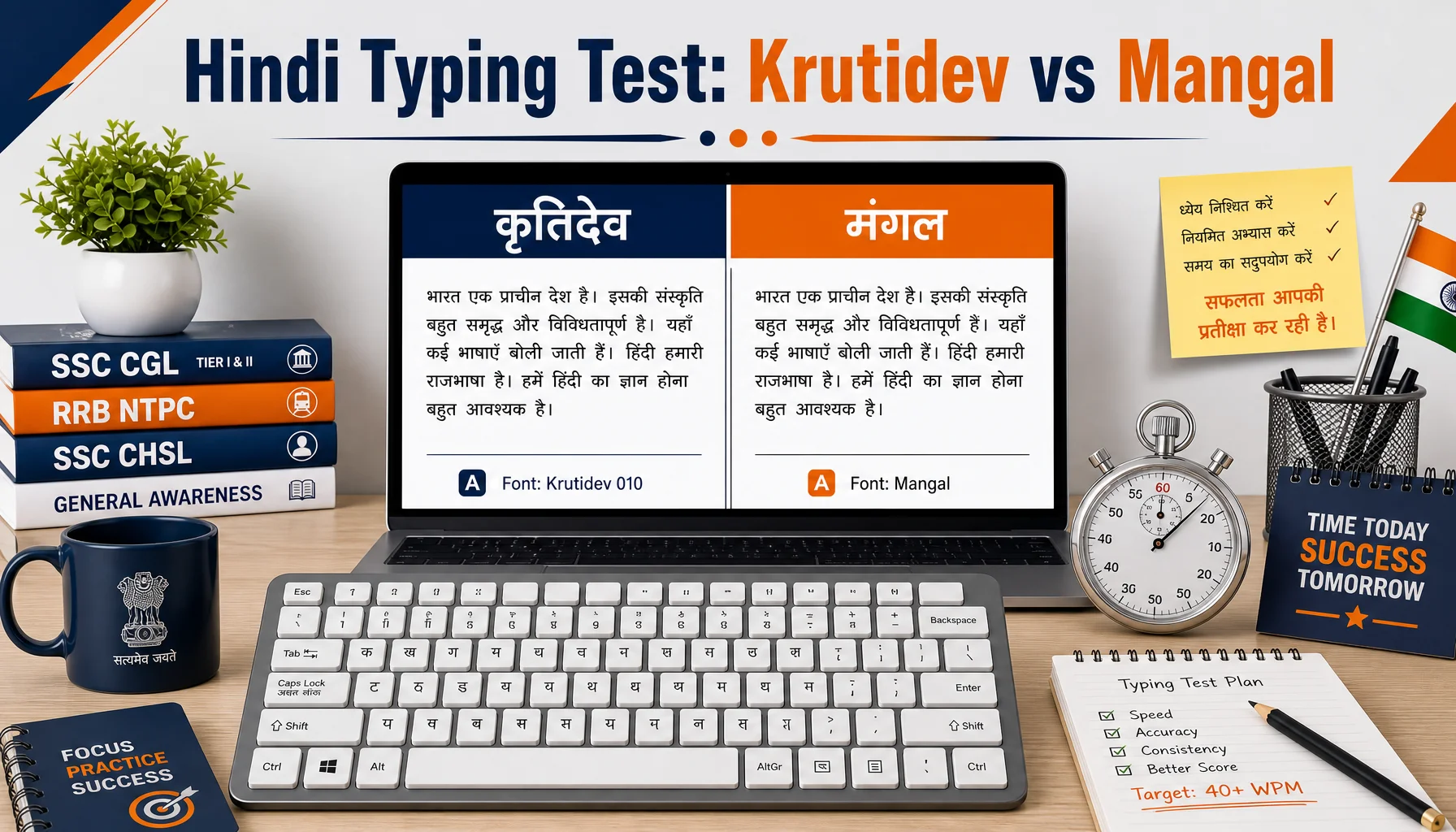
If you’re preparing for a government job through the SSC (Staff Selection Commission) or RRB (Railway Recruitment Board), chances are you’ll need to clear a Hindi typing test. For many candidates, this stage becomes a major hurdle—not because Hindi typing is impossible, but because of confusion around fonts, keyboard layouts, and effective practice methods. Should you learn Krutidev or Mangal? What’s the difference between Remington and Inscript keyboards? How do you build speed and accuracy in Devanagari? This guide answers all these questions and gives you a clear roadmap to succeed.Mining Sirdar Jobs
Why Hindi Typing Matters in SSC & RRB Exams
Several government positions—such as Data Entry Operator, Junior Secretariat Assistant, Lower Division Clerk, and various railway clerical roles—require a demonstrated proficiency in Hindi typing. The typing test is usually a qualifying stage, meaning you must meet a minimum speed and accuracy threshold to move forward, even if your written exam score is excellent.
Typical requirements include a speed of around 25–30 words per minute (WPM) in Hindi, though the exact benchmark varies by post and notification. Because it’s a qualifying test, ignoring your Hindi typing preparation can cost you an otherwise well-earned selection.
Understanding Devanagari Typing: The Basics
Hindi is written in the Devanagari script, which is far more complex than the Roman alphabet used for English. Devanagari involves consonants, vowels, matras (vowel signs), conjunct characters (half-letters combined together), and special symbols. This complexity is exactly why font and keyboard layout choices matter so much when typing.UP Home Guard Result
Two main elements define your Hindi typing setup:
- The font: Krutidev or Mangal.
- The keyboard layout: Remington or Inscript.
Choosing the right combination for your exam is the first strategic decision you must make.
Krutidev vs Mangal: What’s the Difference?
This is the most common source of confusion for aspirants. Let’s break it down clearly.
Krutidev Font
Krutidev is a non-Unicode font. It uses a static encoding system, meaning the characters are mapped to specific keys in a fixed way. Krutidev is traditionally paired with the Remington keyboard layout, which mimics the old Hindi typewriter arrangement.
- Older, widely used in traditional typing institutes.
- Requires memorizing key positions that don’t follow phonetic logic.
- Text may not display correctly on all devices or websites without the font installed.
- Preferred by candidates who already trained on typewriters or old software.
Mangal Font
Mangal is a Unicode font. Unicode is the modern universal standard for representing text, which means Mangal displays correctly across devices, browsers, and platforms without needing special installation. Mangal is typically paired with the Inscript keyboard layout, though it can also be used with Remington via specific tools.Exam Preparation
- Modern standard adopted by most government exams today.
- Inscript layout is designed logically, grouping vowels and consonants systematically.
- Compatible with all modern systems—no font installation issues.
- Increasingly the default requirement in SSC and RRB typing tests.
Which One Should You Choose?
Always check the official exam notification first. In recent years, SSC has largely shifted to Mangal (Unicode) for its typing and data entry tests, while some RRB and state-level exams may still allow Krutidev. If both are permitted, beginners often find Mangal with Inscript easier to learn because of its logical structure, whereas those with typewriter experience may lean toward Krutidev with Remington.
Keyboard Layouts Explained
Remington Layout
Based on the mechanical Hindi typewriter, the Remington layout distributes characters in a non-intuitive way that requires dedicated memorization. It’s the natural partner for Krutidev. If you learned Hindi typing years ago at a coaching center, this is likely the layout you know.
Inscript Layout
Developed and standardized for Indian languages, Inscript places vowels on the left side of the keyboard and consonants on the right, following a phonetic and systematic order. It’s used with Mangal and is generally considered easier for newcomers because the arrangement follows the logic of the language itself.
Effective Practice Strategies for Hindi Typing
Knowing the theory is one thing—building real speed and accuracy is another. Here’s how to practice smartly.
1. Master the Keyboard First
Before chasing speed, learn the exact position of every key without looking. Spend the first week or two doing slow, deliberate practice. Muscle memory is the foundation of fast typing.
2. Prioritize Accuracy Over Speed
SSC and RRB tests penalize mistakes heavily. A high WPM with many errors will fail you. Aim for 95%+ accuracy first; speed naturally follows as your fingers become familiar with the layout.
3. Practice Conjunct Characters
Half-letters and conjuncts (like क्ष, त्र, ज्ञ, and श्र) trip up most learners. Dedicate specific practice sessions to these combinations, since exam passages will contain them frequently.
4. Use Timed Mock Tests
Simulate real exam conditions with timed passages of the same length and difficulty as the actual test. This builds stamina and reduces exam-day anxiety. Many online platforms offer free Hindi typing tests in both Krutidev and Mangal.
5. Analyze Your Errors
After each mock test, review which keys or characters you type incorrectly most often. Targeted correction of these weak spots is far more efficient than repeating random practice.
6. Practice Daily and Consistently
Even 30–45 minutes of focused daily practice beats occasional long sessions. Consistency locks in muscle memory and steadily increases speed over weeks.
Common Mistakes to Avoid
- Ignoring the notification: Practicing on the wrong font wastes valuable time.
- Looking at the keyboard: This limits your maximum speed—force yourself to touch-type.
- Skipping accuracy: Speed without accuracy means automatic disqualification.
- Not practicing full passages: Typing isolated words won’t prepare you for the flow of a real test.
- Cramming at the last minute: Typing speed develops gradually; start at least a month in advance.
Conclusion
Clearing the Hindi typing test for SSC and RRB exams is entirely achievable with the right preparation. Start by confirming whether your exam requires Krutidev or Mangal, then choose the matching keyboard layout—Remington or Inscript. Focus your early practice on mastering key positions and accuracy before pushing for speed, and use timed mock tests to build exam-day confidence. With consistent daily effort and a clear strategy, you can turn this qualifying hurdle into one of your strongest scoring stages. Begin practicing today, and you’ll type your way to that government job with confidence.

About the Author
kasi muraliprasad
A dedicated content writer specializing in government job notifications and results. With two years of experience covering SSC, UPSC, Banking, Railways, and State PSC examinations, he delivers reliable, well-researched updates tailored for serious government job aspirants.