
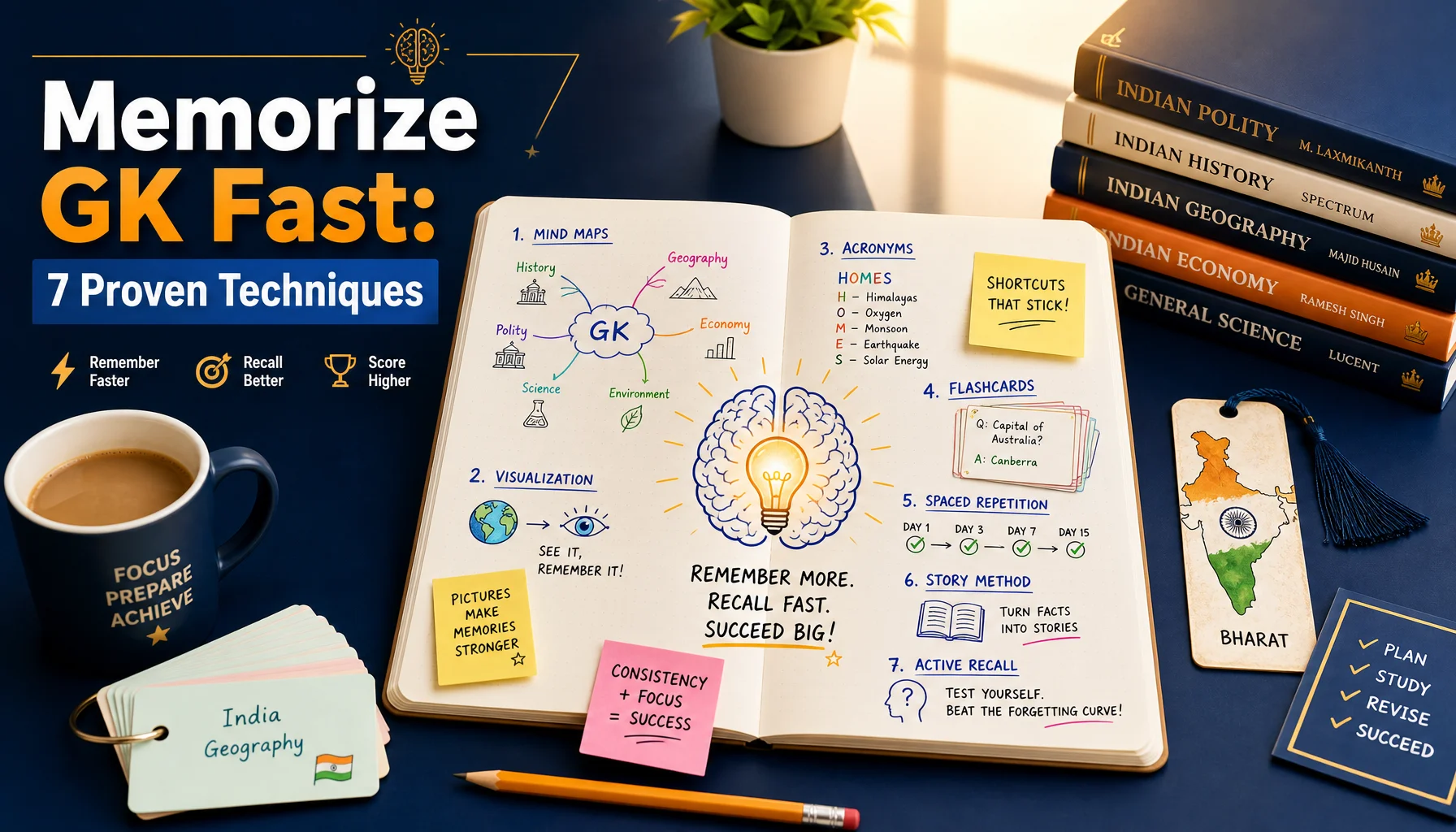
Cracking competitive and entrance exams often comes down to one intimidating challenge: memorizing vast amounts of general knowledge. From historical dates and geographical facts to scientific discoveries and current affairs, the sheer volume can feel overwhelming. But here’s the good news—memory is a skill, not a fixed talent. With the right techniques, you can absorb and retain enormous amounts of GK faster than you ever thought possible. In this guide, we’ll explore seven proven, science-backed strategies that will transform the way you study and dramatically boost your exam performance.online registration
Why Traditional Rote Learning Fails
Most students default to reading the same facts over and over, hoping they’ll stick. Unfortunately, this passive approach is inefficient. Our brains are wired to remember meaningful connections, vivid images, and emotionally charged information—not dry lists repeated endlessly. The techniques below work with your brain’s natural design, making memorization faster and far more durable.
1. Use Mnemonics to Encode Complex Information
Mnemonics are memory shortcuts that turn hard-to-remember data into something catchy and easy to recall. They’re especially powerful for lists, sequences, and categories that appear frequently in GK sections.
- Acronyms: Turn the first letters of items into a word. For example, “VIBGYOR” for the colors of the rainbow (Violet, Indigo, Blue, Green, Yellow, Orange, Red).
- Acrostics: Create a sentence where each word’s first letter cues an item. “My Very Educated Mother Just Served Us Noodles” for the order of planets.
- Rhymes and songs: “In fourteen hundred ninety-two, Columbus sailed the ocean blue” sticks because rhythm aids recall.
The more absurd or funny your mnemonic, the better it works—your brain loves the unusual.
2. Build a Memory Palace (Method of Loci)
Used by memory champions worldwide, the Memory Palace technique links information to specific locations in a familiar place, like your home. vice principal recruitment To use it:
- Choose a route you know well—your bedroom, kitchen, living room.
- Assign each fact to a specific spot along the route.
- Create vivid mental images connecting the fact to that location.
For example, to remember national capitals, imagine the Eiffel Tower crashing through your front door (Paris), and a giant clock (Big Ben) ticking on your sofa (London). When you mentally “walk” through your palace during the exam, each location triggers the associated fact. This spatial method leverages your brain’s strong visual and location memory.
3. Apply Spaced Repetition
Cramming might get facts into short-term memory, but they vanish quickly. Spaced repetition is the antidote. Instead of reviewing everything at once, you revisit information at increasing intervals—right before you’re about to forget it.
A simple schedule might look like this:
- Review new material after 1 day
- Again after 3 days
- Then after 1 week
- Then after 2 weeks, and so on
Apps like Anki and Quizlet automate this process using digital flashcards, making them ideal for GK preparation. Each review strengthens the memory trace, moving facts into long-term storage where they stay retrievable for months.online test series
4. Master Active Recall
Rereading notes feels productive but creates a dangerous illusion of knowledge. Active recall—forcing yourself to retrieve information from memory—is far more effective. Studies consistently show that testing yourself dramatically improves retention.
How to practice active recall:
- Cover your notes and write down everything you remember on a topic.
- Use flashcards with a question on one side and the answer on the other.
- Solve previous years’ GK question papers without looking at answers first.
- Explain a topic aloud as if teaching someone else.
Every time you struggle to recall something and eventually retrieve it, you strengthen that neural pathway—making future recall easier.
5. Chunk Information into Manageable Groups
Your working memory can only hold about 5–9 items at once. Chunking beats this limit by grouping individual pieces into larger, meaningful units. Think of how phone numbers are broken into segments rather than one long string.
For GK, you can chunk by:
- Themes: Group all Nobel Prize winners together, or all UN organizations.
- Time periods: Organize historical events by century or era.
- Categories: Cluster rivers, mountains, and deserts under geography sub-headings.
Chunking makes large volumes of data feel structured and digestible instead of chaotic.
6. Connect New Facts to What You Already Know
Isolated facts are hard to remember, but facts woven into a web of existing knowledge stick effortlessly. This is called elaborative encoding. When you learn something new, ask yourself:
- How does this relate to something I already know?
- Why is this fact true or important?
- What story or logic connects the pieces?
For instance, instead of memorizing that the Amazon is the largest rainforest, connect it to the Amazon River, the countries it flows through, and its role in producing oxygen. These associations create multiple retrieval paths, so even if one clue fails, another will trigger the memory.
7. Visualize and Use the Storytelling Method
Our brains remember stories far better than isolated data. Transform sequences of facts into a narrative or a series of vivid mental images. For example, to remember a chain of historical events, imagine them as scenes in a movie, with each event flowing logically into the next.
Visualization also works wonders for individual facts. If you need to remember that “Tokyo is the capital of Japan,” picture a giant “toy” (Tokyo) sitting on top of the Japanese flag. The stranger and more colorful the image, the more memorable it becomes.
Bonus Tips to Supercharge Your Memory
- Sleep well: Memory consolidation happens during sleep, so never sacrifice rest before an exam.
- Stay physically active: Exercise boosts blood flow to the brain and improves cognitive function.
- Study in short, focused sessions: Use the Pomodoro technique—25 minutes of study followed by a 5-minute break.
- Read newspapers daily: For current affairs, consistency beats last-minute cramming every time.
Conclusion
Memorizing general knowledge quickly isn’t about having a photographic memory—it’s about using smart, proven techniques that align with how your brain naturally works. By combining mnemonics, memory palaces, spaced repetition, active recall, chunking, meaningful connections, and storytelling, you’ll retain more GK in less time and with far less stress. Start applying just two or three of these methods today, build them into a consistent routine, and watch your confidence—and your exam scores—soar. Success in competitive exams isn’t reserved for the naturally gifted; it belongs to those who study strategically.

About the Author
Rajeswari Ramagiri
content writer with 2 years of experience specializing in government job notifications and results. He covers the latest updates across major recruitment sectors including SSC, UPSC, Banking (IBPS, SBI, RBI), Railways (RRB), State PSCs, and other central and state government departments. From exam notifications and admit cards to answer keys, cut-offs, and final results, he delivers accurate and timely information to help aspirants stay ahead in their preparation. With a clear and aspirant-friendly writing style, he simplifies complex recruitment details and guides candidates at every stage of their government job journey